Loravenax Expandable Kitchen Drawer Organizer with Divided Cutlery Storage, Sliding Side Trays & Warm Wood-Grain Finish
Loravenax Expandable Kitchen Drawer Organizer with Divided Cutlery Storage, Sliding Side Trays & Warm Wood-Grain Finish
Couldn't load pickup availability

Loravenax Expandable Kitchen Drawer Organizer with Divided Cutlery Storage, Sliding Side Trays & Warm Wood-Grain Finish
🧩 Open the Drawer. Find What You Came For.
A teaspoon should not take a search party. Neither should the whisk you use every weekend or the serving spoon you need just as dinner reaches the table. When everything shares one open drawer, even familiar tools can disappear under something else.
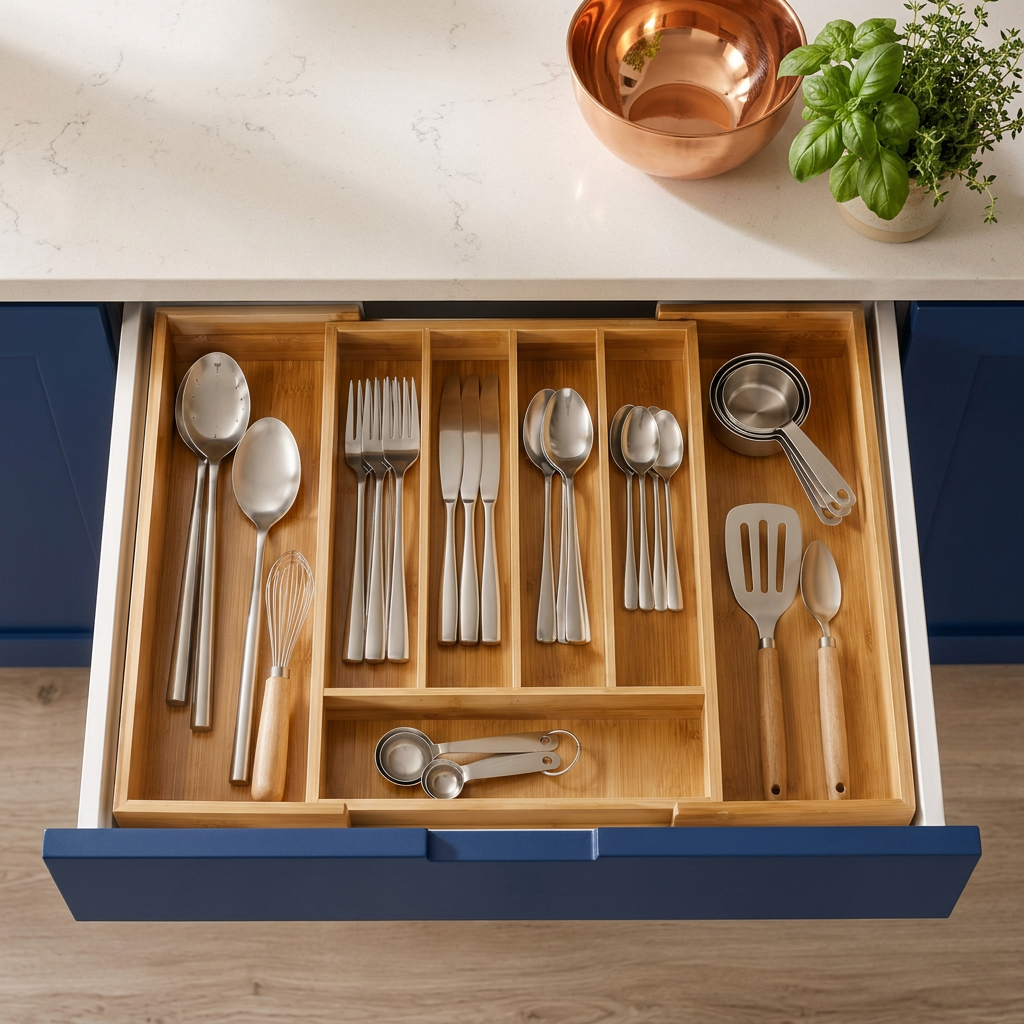
The Loravenax Expandable Kitchen Drawer Organizer gives that everyday space a clearer plan. Long central channels separate your cutlery, a shorter crosswise section creates a home for smaller pieces, and sliding side trays offer space for compatible larger utensils. A warm golden wood-grain appearance brings the whole arrangement together, so the drawer looks considered rather than simply filled.
This is not about owning fewer useful tools. It is about knowing where each one belongs.
🗺️ Your Drawer, Reimagined as Three Useful Zones
Zone One: the everyday cutlery lanes
The pictured layout includes four long central compartments. Assign a lane to forks, another to table knives, one to larger spoons and one to teaspoons. Keeping similar pieces aligned gives you a direct view of what is available, instead of making you lift one utensil to identify another beneath it.
Arrange handles in the same direction and keep stacks low enough to lift comfortably. Your drawer does not have to look like a showroom. It just needs a consistent pattern that makes sense when you are reaching for breakfast cutlery or setting the table in a hurry.
Zone Two: the small-item landing place
A transverse compartment across the front of the central section creates a different shape of storage. It is a useful place to consider for compatible measuring spoons or other short kitchen pieces that tend to get lost between longer utensils. Group small items by purpose rather than letting them drift across the entire drawer.
Zone Three: the longer side spaces
The expandable sides provide long storage areas beside the cutlery section. In the reference arrangement, these areas accommodate larger serving utensils, a whisk and measuring tools. Use them for items whose length and width suit the actual compartment dimensions, and leave enough clearance to lift each piece without catching its neighbor.
📏 Fit Comes First, Organization Comes Next
Expandable does not mean universal. Before choosing your layout, measure the inside of the drawer rather than the cabinet front. You need the usable width, front-to-back depth and clear height available when the drawer closes.
Check for interior rails, screws, sloping sides or other obstructions that reduce usable space. Compare those measurements with the organizer's confirmed closed and expanded dimensions. Also consider the height of the utensils you intend to store: a deep ladle or stacked cutlery may need more closing clearance than the empty organizer.
The side sections allow the organizer's footprint to adapt within its specified adjustment range. Set them to a suitable width without forcing them against the drawer walls, and make sure the base is supported evenly. Exact measurements and extension limits must be checked against the supplier's specifications before purchase.
🧭 A Drawer Reset You Can Actually Maintain
- Start with an empty space. Remove the contents, wipe the drawer and let it dry. Seeing the full area makes it easier to judge what belongs there.
- Sort by how you use things. Put everyday cutlery together, separate serving tools, and collect smaller measuring pieces into their own group.
- Check the fit before loading. Place the organizer in the drawer and adjust the side trays within the confirmed range. Test that the drawer opens and closes freely.
- Give each group a defined home. Use the central lanes for compatible cutlery, the shorter section for smaller pieces and the long side areas for suitable larger tools.
- Leave some breathing room. Avoid filling compartments so tightly that taking out one item pulls out several. A practical layout is one you can use, not just photograph.
Once the arrangement works, keep it consistent. Putting a clean fork back into its own lane is a smaller task than sorting a mixed drawer again next month.
🪵 Warm Grain, Clear Lines, Less Visual Noise
The organizer's golden wood-grain appearance adds warmth to the inside of a drawer, balancing the cooler shine of metal cutlery. Straight dividers create a readable layout, while the surrounding tray edges give the whole collection a more contained appearance.
Against white cabinetry, the warm tone becomes a quiet contrast. In a darker kitchen, it introduces a lighter layer when the drawer opens. The appeal is not elaborate decoration; it is the combination of visible texture and an orderly arrangement that makes an ordinary storage space feel cared for.
The photograph does not establish the exact material composition, coating or certification. No specific wood species, bamboo composition, food-contact certification or environmental claim is implied by the wood-grain appearance.
⏳ What Changes Between Breakfast and Dinner?
At breakfast: open the drawer and go directly to the teaspoons. There is no need to shift a serving tool just to reach the smaller cutlery underneath.
During meal preparation: keep measuring spoons in their own section and longer tools beside the central tray. You can see the category you need before picking up a piece.
When setting the table: forks and knives remain grouped, making it easier to collect place settings without sorting a mixed pile on the counter.
After washing up: dry the utensils fully and return them to the same positions. The organization is reinforced by the routine itself, not by an occasional major cleanup.
Picture a busy evening: someone is cooking, someone else is laying out plates, and a clean load of cutlery is ready to put away. A shared layout gives everyone the same visual guide. The drawer becomes easier to understand even when more than one person uses the kitchen.
🧺 Organize for Real Life, Not Maximum Packing
- Choose accessibility over density. Low, orderly stacks are easier to use than crowded piles.
- Keep similar shapes together. Separate teaspoons from larger spoons so the smaller pieces remain visible.
- Respect the compartment length. Oversized tools should not sit diagonally across dividers or prevent the drawer from closing.
- Reassess occasional-use items. If a bulky utensil crowds the pieces you use daily, consider another suitable storage location.
- Store sharp items safely. This divided tray is not a protective knife block. Use appropriate guards and storage for sharp blades.
🧴 Simple Care for an Everyday Storage Piece
Only return clean, fully dry utensils to the organizer. Wipe loose crumbs from the compartments regularly, paying attention to the corners where the dividers meet the base. For cleaning, follow the supplier's directions for the confirmed material and finish.
A soft cloth and prompt drying are a sensible starting point where permitted. Avoid soaking, standing water, abrasive scrubbing or dishwasher cleaning unless the manufacturer specifically confirms those methods are suitable. Keep the organizer dry before placing it back inside the drawer, and periodically check that the side sections remain properly positioned.
📝 The Questions That Matter Before It Goes in Your Drawer
Will it fit every kitchen drawer?
No universal fit is promised. Compare your drawer's internal width, depth and closing clearance with the confirmed organizer measurements, including its extension range.
Can the dividers be moved?
The reference shows divided central storage and sliding side sections. Removable or independently repositionable internal dividers are not confirmed.
What can I store in it?
Compatible cutlery, measuring spoons and suitable kitchen utensils are practical options. Match each item to the actual compartment dimensions and avoid overloading or unsafe blade storage.
Does it come with the utensils in the pictures?
Cutlery, whisks, measuring tools and other styling props are shown to demonstrate organization ideas. They are not included unless expressly stated in the confirmed package list.
Is it a drying rack?
No. Use it as drawer storage for clean, dry items, not as a place to leave wet utensils to drain.
🎯 Give One Busy Drawer a Better System
You do not need to reorganize the whole kitchen to make one daily task easier. Start with the drawer you open most. Separate the cutlery, give the smaller pieces a place, and let the larger utensils sit alongside rather than on top of everything else.
The Loravenax Expandable Kitchen Drawer Organizer combines divided storage, adaptable side space and a warm wood-grain look in one practical layout. Measure first, arrange it around the tools you use, and enjoy a drawer that makes sense each time you open it.
Make room for a more organized routine for $39.99 USD.